Yangtze University Launches Intelligent Logging Institute
On the morning of November 10, the unveiling ceremony of the Intelligent Logging Research Institute of Yangtze University and the 2026 High-Level Forum on Intelligent Logging were held at the university's East Campus in the Petroleum Lecture Hall. More than 100 experts, scholars, representatives from research institutions, and industry professionals gathered to discuss the intelligent transformation of logging technologies for deep-earth and deepwater exploration.
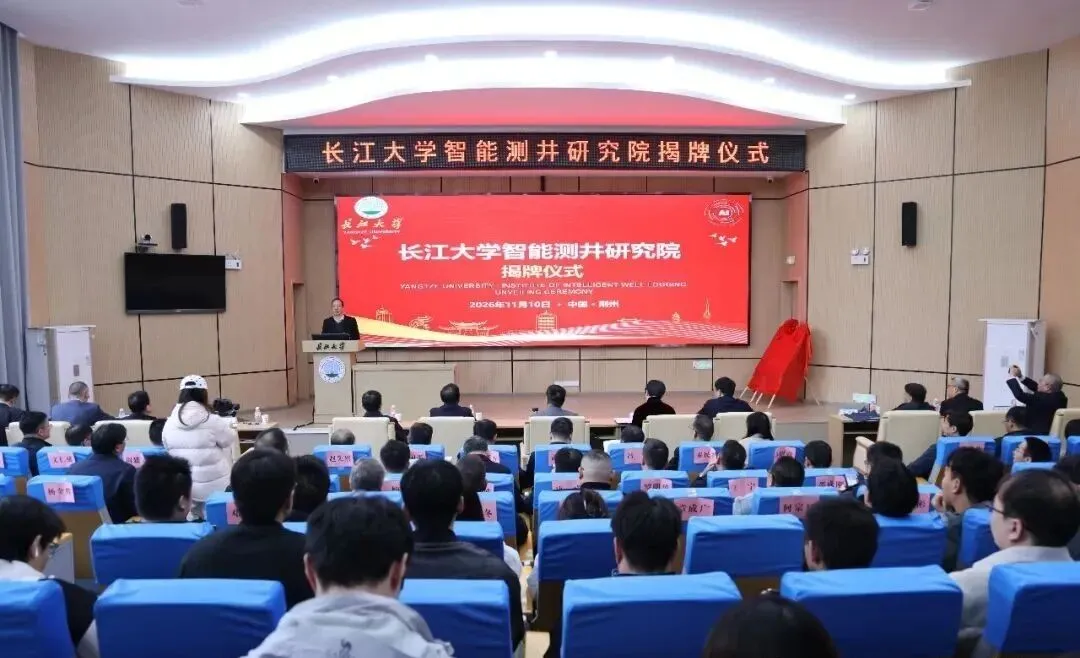
Attendees included Wu Xiaolin, Vice President of the China Petroleum Education Association and Director of its Higher Education Committee; Hu Qiyue, Director of the Petroleum Logging Committee of the China Petroleum Society; Wu Han, Deputy General Manager and Safety Director of China National Logging Corporation (CNLC); Zhou Jun, Chief Expert of CNLC; Rao Haitao, Chief Expert of Sinopec Geophysical Corporation; Wang Yujue, Deputy General Manager of the Oilfield Technology Division of China Oilfield Services Limited (COSL); Xiao Lizhi, Founding Dean of the School of Artificial Intelligence at China University of Petroleum-Beijing; Ao Tinghua, Deputy Party Secretary of Yangtze University; and Guo Haimin, former Vice President of Yangtze University. The event was chaired by Jiang Wanzhe, Member of the Standing Committee of the University's Party Committee and Director of its Publicity Department.
In his opening remarks, Ao Tinghua thanked the guests for their continued support of the university and introduced its educational development and recent achievements. He noted that China's 15th Five-Year Plan calls for a new round of strategic initiatives to accelerate breakthroughs in mineral exploration. The establishment of the Intelligent Logging Research Institute represents the university's proactive response to national priorities and will create better conditions for the development of logging disciplines, talent cultivation, and technological innovation, while promoting the advancement of related disciplines.
Hu Qiyue highlighted Yangtze University's historical contribution to the development of China's logging discipline, whose academic origins can be traced back to an advanced geophysical exploration training program established by Academician Weng Wenbo in Shanghai in 1950. Over the past seven decades, the university has trained a large number of professionals for China's petroleum industry.
He noted that logging technology is now at a critical transition point from conventional methods to intelligent applications. The establishment of the institute is therefore timely and strategically significant.
Hu put forward three priorities for the institute's future development:
First, it should pursue distinctive development by translating its academic strengths into technological advantages, focusing on intelligent interpretation, complex reservoir evaluation, and intelligent downhole sensing and control.
Second, it should strengthen open collaboration with the three major national oil companies, universities, and research institutions, promoting deeper integration of industry, academia, research, and practical applications so that laboratory achievements can be rapidly deployed in the field.
Third, it should prioritize talent development and innovate its educational approaches, allowing students to develop practical capabilities through real-world challenges and field applications.
Deng Rui, Director of the Intelligent Logging Research Institute, presented the institute's development plan, covering its existing foundation and strategic positioning, organizational structure, research priorities, objectives, and implementation measures.
In the presence of the attendees, Wu Xiaolin and Ao Tinghua jointly unveiled the institute. A donation ceremony was also held, during which Hangzhou Fenghe Petroleum Technology Co., Ltd. and other organizations donated logging instrument models and petroleum software to the university. Ao Tinghua presented donation certificates to the corporate representatives.
Following the unveiling ceremony, the 2026 High-Level Forum on Intelligent Logging was held. Li Ning, Member of the Chinese Academy of Engineering, delivered a keynote presentation titled "Information Technology Application Innovation: Major Opportunities for the Development of China's Intelligent Oil and Gas Industrial Software Amid a Century of Unprecedented Global Change."
Focusing on the development of CIFLog logging software, its technological innovations, and industrial applications, Li reviewed China's progress in logging software, from technology introduction and independent research to breakthroughs in critical areas.
During the discussion session, participating experts offered recommendations for the institute's development. They expressed their commitment to strengthening industry-academia-research collaboration in areas including logging large language models, intelligent reservoir evaluation, equipment intelligence, intelligent data processing, and complex reservoir characterization. Their goal is to help the institute become a leading center for innovation, talent development, and technology commercialization while supporting China's national energy security strategy.
In the afternoon, experts from China National Logging Corporation, Sinopec Geophysical Corporation, China Oilfield Services Limited, and the Institute of Geology and Geophysics of the Chinese Academy of Sciences presented their respective perspectives on the current development and future outlook of intelligent logging technologies.