11th ECF Tech Awards - Scientific and Technological Progress Award - Bronze Award
Project:Key Technologies for Speed-up and Efficiency-improvement of Pre-CO₂ Volume Fracturing
Company:CNPC Chuanqing Drilling Engineering Co., Ltd., Changqing Downhole Technology Company
Project Title: Key Technologies for Speed-up and Efficiency-improvement of Pre-CO₂ Volume Fracturing in Unconventional Reservoirs
Participating Enterprises: CNPC Chuanqing Drilling Engineering Co., Ltd., Changqing Downhole Technology Company
Award Received: Scientific and Technological Progress Award
Project Number: ECF-2026-SYE-1005
Main Participants: Bai Mingwei, Chai Long, Ye Sai, Lan Jianping, Zhong Xinrong, Zhang Tiejun, Yang Min, Yao Wei, Liao Ming, Huang Yujie
Expert Review Comments:
This achievement improves the field implementation of CO₂-prepad fracturing by addressing discontinuous supply, equipment coordination and limited treatment efficiency. Reservoir-mechanism studies are combined with high-rate supply, continuous replenishment and alternating injection using a single pumping spread. The equipment supports 12 m³/min, and field applications show an increase from 0.8 to 1.5 stages per day, demonstrating the direct benefit of supply and operational improvements. The project provides engineering support for using CO₂ to add reservoir energy, reduce oil viscosity and assist fluid recovery. It offers efficiency gains in suitable tight-reservoir applications and valuable operating experience for wider CO₂-fracturing deployment.
Main Innovations:
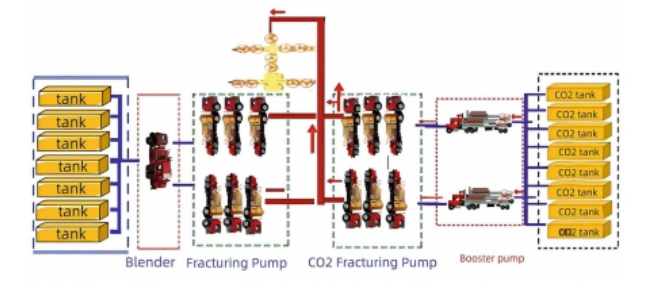
To address challenges including limited CO2 fracturing scale constrained by equipment operation capacity, low operational efficiency, and unclear operation mechanisms for unconventional reservoirs, a series of CO2 fracturing operation equipment was developed based on high-rate stable fluid supply, automatic continuous fluid replenishment and real-time metering. Multiple speed-boosting and efficiency-enhancing technologies were optimized and established, such as high-rate stable fluid supply, continuous filling and replenishment, and alternating injection by single-unit sets. The stimulation mechanism of CO2 fracturing was revealed based on the evaluation of CO2-unconventional oil-gas displacement laws. Pre-CO2 fracturing achieved an operation scale with a displacement of 12 m³/min and single-stage carbon supply of 800 m3. Fracturing operational efficiency was increased from 0.8 stages per day to 1.5 stages per day. The average single-well production capacity was improved by 10%- 30% compared with hydraulic fracturing. The overall technology has reached the internationally advanced level.
Main Uses and Technical Principles:
Applicable to the stimulation of unconventional reservoirs including tight oil and gas, shale oil and gas, and coal-rock gas, this technology deeply integrates pre-CO2 treatment with volume fracturing. It takes full advantage of CO2’s capabilities in formation energization and permeability enhancement, rock breaking and viscosity reduction, hydrocarbon displacement-desorption and complex fracture network generation to achieve efficient, low-carbon and green development of unconventional oil and gas. Characterized by low viscosity and high diffusivity, CO2 penetrates into reservoir matrix and natural fractures, activates bedding micro-fractures to form complex fracture networks, supplements formation energy and facilitates flowback; pre-CO2 volume fracturing utilizes such properties of liquid CO2 to expand the scale and complexity of stimulated fracture networks and improve reservoir stimulation effects. In field practice, 50-300 m liquid CO is injected in advance before switching to water-based fracturing fluid. Adopting single-unit alternating injection of dual media reduces equipment occupancy and site footprint and simplifies field workflows. Supporting facilities such as nitrogen pressurization and electric-drive pump skids ensure high-rate stable fluid supply, continuous fluid-replenishing devices realize non-stop filling, high-precision metering and centralized data acquisition enable digital control, and concentration as well as leak-point monitoring systems guarantee construction safety.